Policy and compliance · for Kubernetes clusters
Score your cluster against the frameworks you answer to, and close each gap.
AuthFI reads what is running in your cluster, scores it against nine frameworks and AuthFI's AI baseline, names the rule that closes each gap, and works with the Kyverno policies you already have.
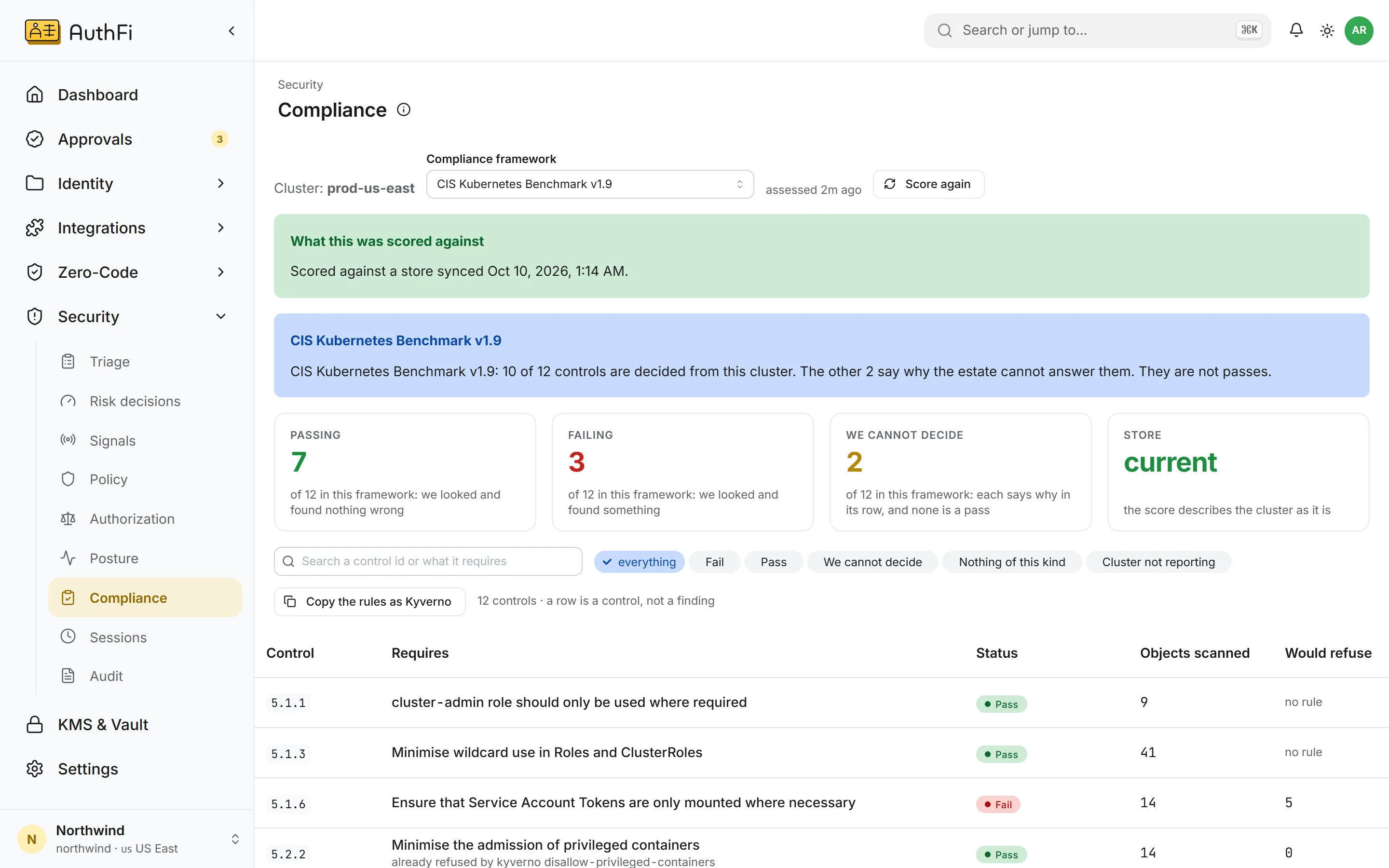
A cluster, scored
One cluster against a framework's controls. Only a pass is a pass; a control that cannot be decided says why.
Nine frameworks and AuthFI's AI baseline, one scan
83 controls in the catalogue. A cluster's own objects can decide some of them; every other control is listed with the reason it cannot be decided from a cluster.
CIS Kubernetes Benchmark
v1.9
13 controls
SOC 2
Trust services criteria
3 controls
ISO/IEC 27001
2022
4 controls
NIST SP 800-207
Zero trust, all seven tenets
7 controls
PCI DSS
v4.0
12 controls
HIPAA Security Rule
45 CFR 164 subpart C
21 controls
OWASP Top 10
2021
2 controls
OWASP API Security Top 10
2023
10 controls
OWASP Top 10 for LLM
2025
10 controls
Kernel cage baseline for AI workloads
AuthFI
1 control
Five answers. Only one is a pass.
A report that shows a tick for everything it did not look at is clean by not looking. Every control gets one of five answers, and four of them are not a pass.
Pass
We looked, and found nothing wrong.
Fail
We looked, and found something. Each finding names the object and the part that failed.
Nothing of this kind
We looked, and your cluster has no objects this control applies to.
We cannot decide
Nothing in a cluster can answer this control. The row says why.
Cluster not reporting
The cluster has never reported, so there is nothing to score. Shown as a danger, not a blank.
Closing a gap
The rule that closes each gap, and what it would cost.
For a failing control AuthFI names the rule that would close it. Before you turn anything on, you see how many of your workloads it would refuse and what stops working.
Counted against your cluster as it is now, not predicted
Says what it would disrupt, in words
Arms nothing: a person decides
Works with Kyverno
Kyverno refuses at admission. AuthFI tells you what is worth refusing, reads the policies you already run, and writes the ones you are missing.
Reads the policies you run
It does not tell you to fix what you already fixed.
- A control already refused by one of your Kyverno policies is marked as guarded, with the policy named.
- A policy in Audit mode is not counted as protection. It watches; it does not refuse.
- A rule AuthFI cannot read is named as untranslated, never quietly assumed to cover you.
- Your Kyverno rules appear on the Policy page beside every other rule in force.
Writes the ones you are missing
Copy a complete policy, ready to apply.
apiVersion: kyverno.io/v1
kind: ClusterPolicy
metadata:
  name: disallow-privilege-escalation
spec:
  validationFailureAction: Audit
  background: true
  rules:
    - name: disallow-privilege-escalation
      match:
        any:
          - resources:
              kinds: [Pod]
      validate:
        message: Containers must not allow privilege escalation
        pattern:
          spec:
            =(containers):
              - securityContext:
                  allowPrivilegeEscalation: "false"
Exported policies are set to Audit, so nothing breaks until you choose to enforce.
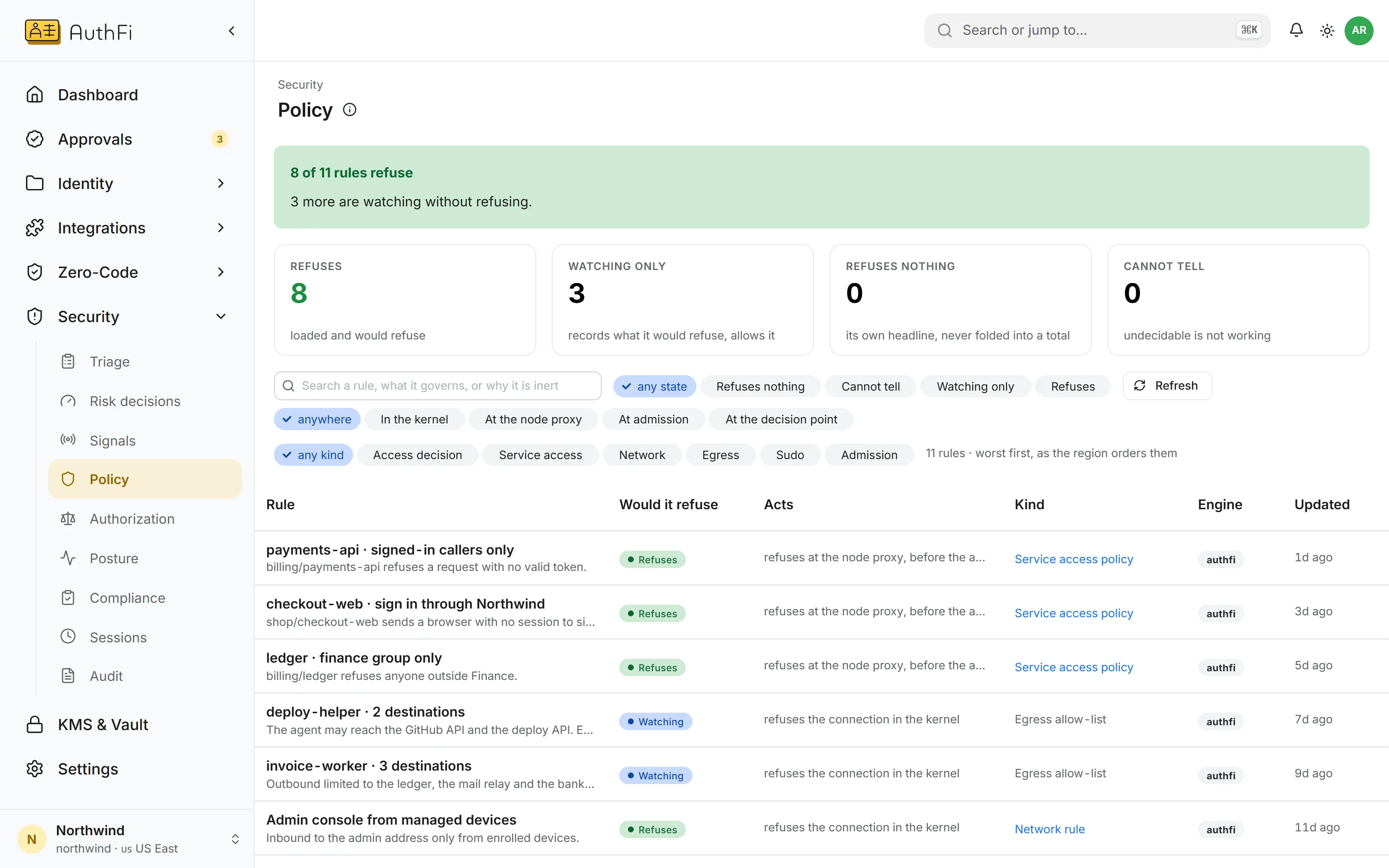
Policy
Every rule in force, and whether it would refuse.
Service access, network, outbound connections, privileged commands, access decisions and your Kyverno admission policies are read together. Each rule gets one honest state.
Refuses, watching, refuses nothing, or cannot tell
Each rule links to the screen that owns it
A source that could not be read is named, not skipped
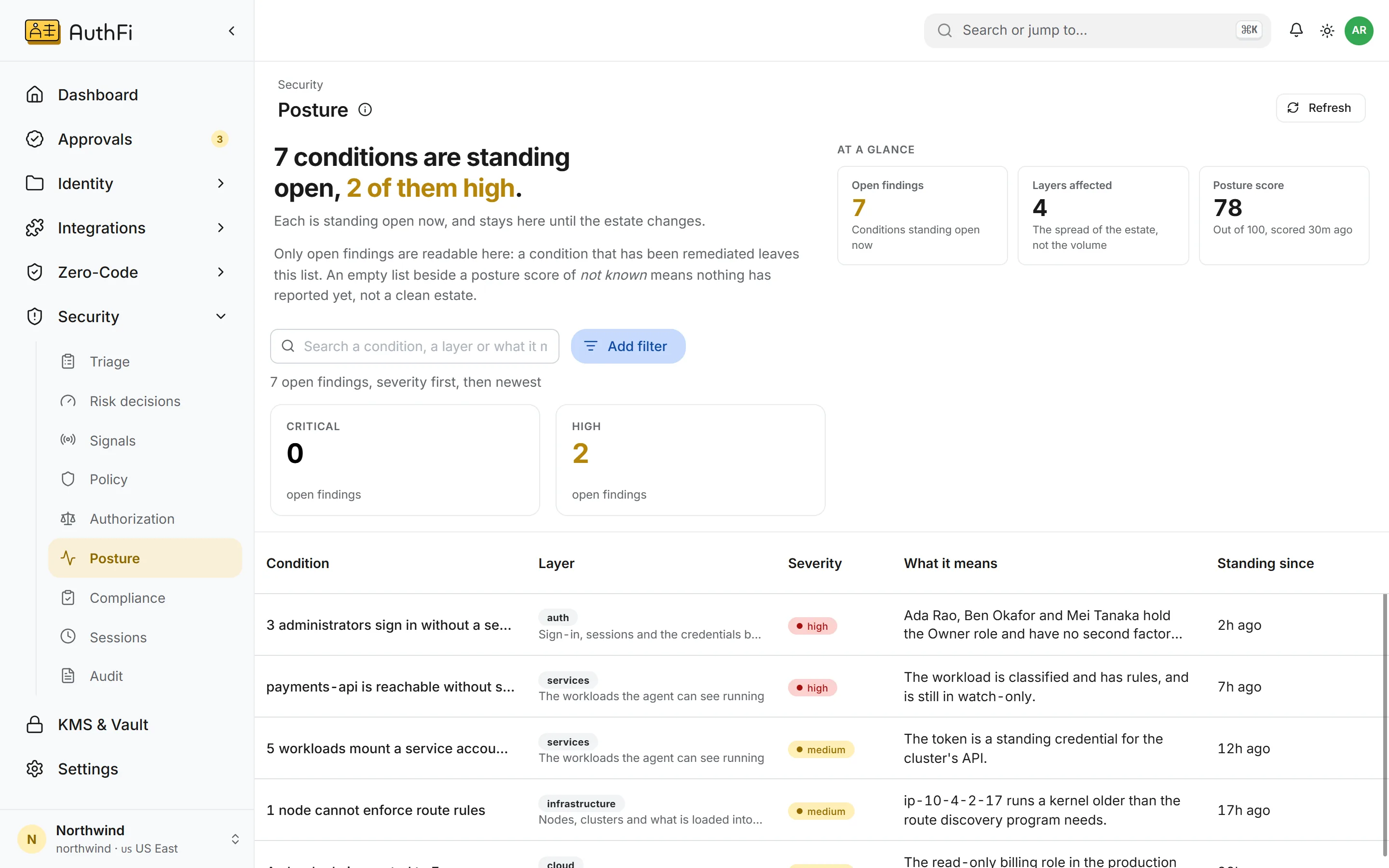
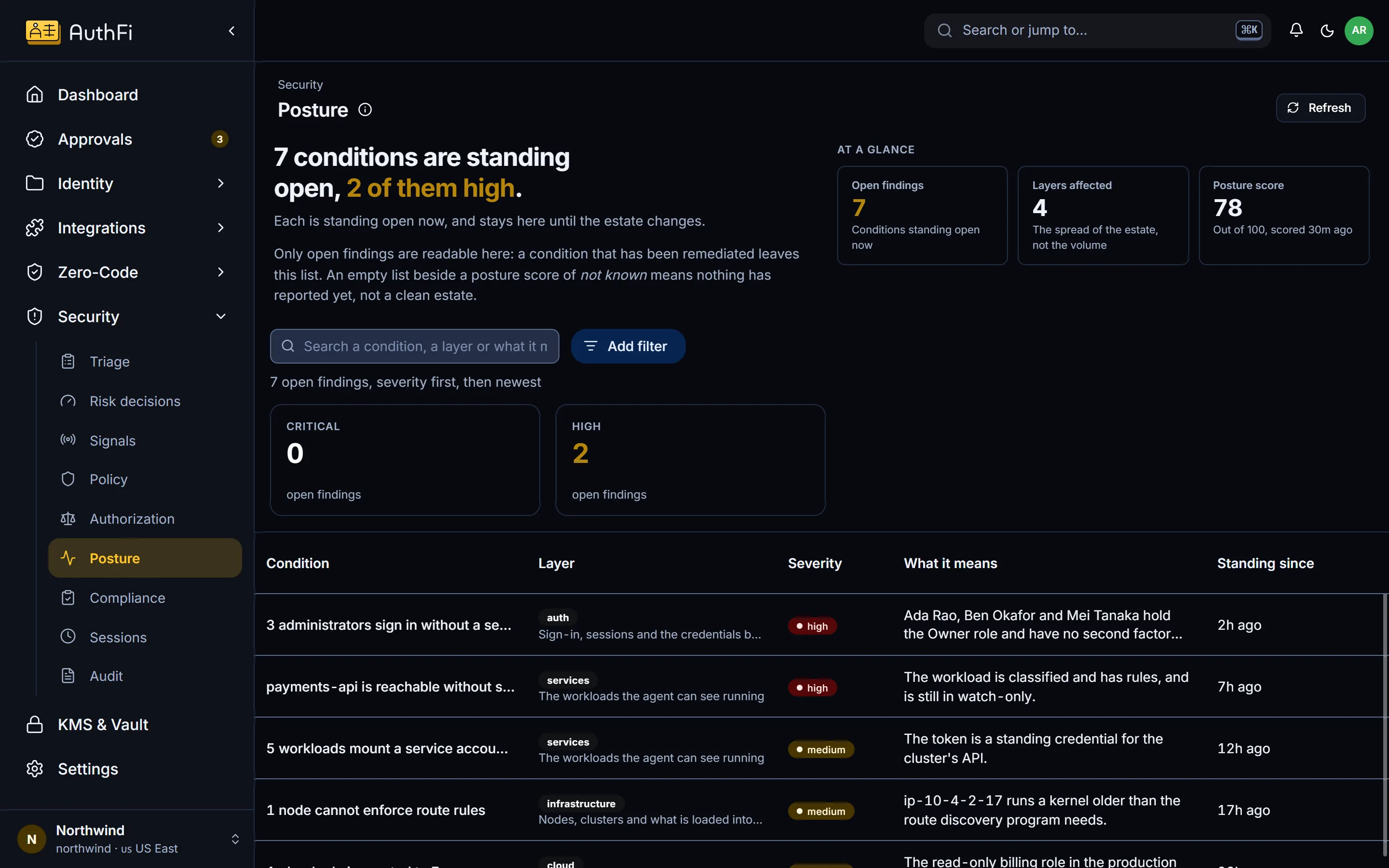
Posture
Standing conditions, not a stream of events.
A finding is a condition that stays open until your estate changes, such as a privileged pod or a server that permits SSH root login.
By layer: sign-in, services, infrastructure and cloud
By severity, so the worst is first
A fixed condition leaves the list
What this is, and what it is not
Stated plainly, because a compliance score is easy to misread.
It is evidence, not a certificateWhat an auditor still does
Not an audit
A score shows how your cluster stands against a framework's technical controls. It does not certify you, and it does not replace your auditor.
Cluster controls only
Controls about your practices, such as training, incident procedures or physical access, cannot be decided from a cluster. They are listed as undecided, with the reason.
As fresh as the last sync
The score describes what the cluster last reported. If that is more than an hour old, the page says so.
Kyverno does the refusing
These rules decide whether an object may exist. They are enforced at admission by Kyverno, which you run. AuthFI's own enforcement is on connections and sign-in.
Where each part standsFive available, one in pilot, one in development
Cluster scored against nine frameworks and AuthFI's AI baseline
The rule that closes each gap, counted against your cluster
Export as Kyverno policies
Recognises the Kyverno policies you already run
Every rule in force, and whether it would refuse
Standing posture findings
Reports for auditors, as a document